
The Montecristo Project
The Montecristo Project: What Is an Augmented Book?
Print, eBooks, QR codes and digital content:
how multi-layered reading works.
An augmented book is a print or digital book that preserves linear reading while offering additional content
– background material, images, audio, video, maps or hyperlinks – accessible through links, QR codes or interactive elements.
These materials remain optional: they enrich the experience without replacing the main text.

Definitions and Differences among the Various Technologies
What Is an Augmented Book?
An augmented book is a text published in print or digital form that, while retaining linear reading, provides access to supplementary materials that provide further insight into or enrich the text.
How Does an Augmented Book Work?
Through QR codes in the print edition and links and QR codes in the digital edition, an augmented book provides access to multimedia content, background material, maps, music, glossaries and updates without interrupting linear reading.
Differences among the Various Technologies: the Integrated Book
For several years now, a large proportion of school textbooks have paired the print edition with a digital component accessible on the web or through dedicated apps. I personally refer to these solutions as integrated books. They often do not use the standard ePub format for electronic books (ePub is an open standard, whereas Kindle and Kobo are proprietary ecosystems that can receive an ePub file and convert it into their own formats).
The web platforms and apps used by integrated books can easily include audio, video and interactive content, such as guided exercises, simulations and activities that use augmented reality through a smartphone or tablet camera.
Integrated books nevertheless have several drawbacks: each publisher tends to develop its own system, which is often not transferable to other platforms. In addition, software and web servers must be continuously maintained and updated, or the work’s interactive component may be lost. Finally, not all of these solutions can function without an internet connection.
The Interactive eBook
An interactive eBook based on the ePub3 standard could, at least in theory, provide many of the functions just described. In practice, however, each reading platform implements only part of the standard and may interpret some of its features differently. Nor does the standard require full scripting support. Consequently, JavaScript, dynamic menus, expandable elements, complex quizzes, interactive maps, modal windows, custom search functions and conditional logic do not necessarily work on every device or in every reading application.
Augmented Reality
Augmented reality, by contrast, is a specific technology: it uses a device’s camera and screen to overlay digital elements on images of the real world—for example, animations, three-dimensional models or additional information displayed over a printed page. It can therefore be one component of an integrated book, but it is not the same thing: a book can be “augmented” through links, QR codes, audio, video, maps or web-based background material without using augmented reality.
Augmented Books in Fiction: Advantages and Limitations
For a work of fiction, developing and maintaining a dedicated app would be difficult and expensive. The most robust solution is therefore to use only essential, widely interoperable features in the EPUB format, while pairing it with a web platform accessible from both the digital and print editions: an augmented book, in other words.
The advantages are clear: linear reading always remains available, regardless of everything else. The additional material is optional and remains available for later readings; it can also be updated at any time.
The current limitations are the need for an internet connection—although this is becoming less and less of a problem—and the need to maintain the web content over time. In the case of The Montecristo Project, doing so is a specific interest and commitment of the author.
A Concrete Example: The Montecristo Project
The term augmented book therefore has a dual meaning. In the digital book, it involves adding further layers of reading—for example, The Montecristo Project’s dedicated wiki (Wikinet), included in the ePub, Kindle and Kobo editions and also available on the web. In the print book, by contrast, it means integrating the possibilities of digital media in order to obtain the best of both worlds.
At present, the simplest and most accessible way to connect a printed book to digital content is the QR code. Virtually everyone now carries a smartphone, and modern smartphones can read QR codes. A QR code can also have an attractive design and include a logo or symbol – or, in this case, a Glyph – at its centre. That is why, after several years of research, I chose this solution for my project.
Not everything went smoothly: the QR codes in the first edition of La Prima Colonia (2022) were created using a third-party platform that was initially free (and promised to remain so), but then abruptly changed its policy and imposed absurd subscription fees. I was therefore forced to adopt a self-hosted solution on my own server, developed by the talented Italian developer Giandonato Inverso.
Anyone who purchased the first print edition of La Prima Colonia, in which the QR codes no longer work, can receive a complimentary digital copy—with a personal dedication—of the second edition (2024): simply email me and attach a photograph of the print book purchased at the time. Readers who bought the digital edition should receive the update automatically, depending on the platform; otherwise, they can request it through the eBook reader they use.
The aspect I consider most important is that an augmented book does not interfere with linear reading: the extra material exists on another level. It can stimulate interest and curiosity, but it does not force readers to stop and explore it. In fact, the whole book can easily be read straight through the first time without using the dedicated wiki or the web pages linked to individual scenes.
I consider this particularly respectful of readers, who are free to choose how deeply they wish to explore the story. This also fits into the broader discussion already addressed about the proper use of information technology – a principle that applies both to “traditional” computing and to artificial intelligence: not replacement, but respectful integration; enrichment that is never imposed.
In addition, the web component of the work can continue to be updated and expanded even after the book has been published, opening up new and unprecedented possibilities for communication between author and readers.
The Digital Augmented Book
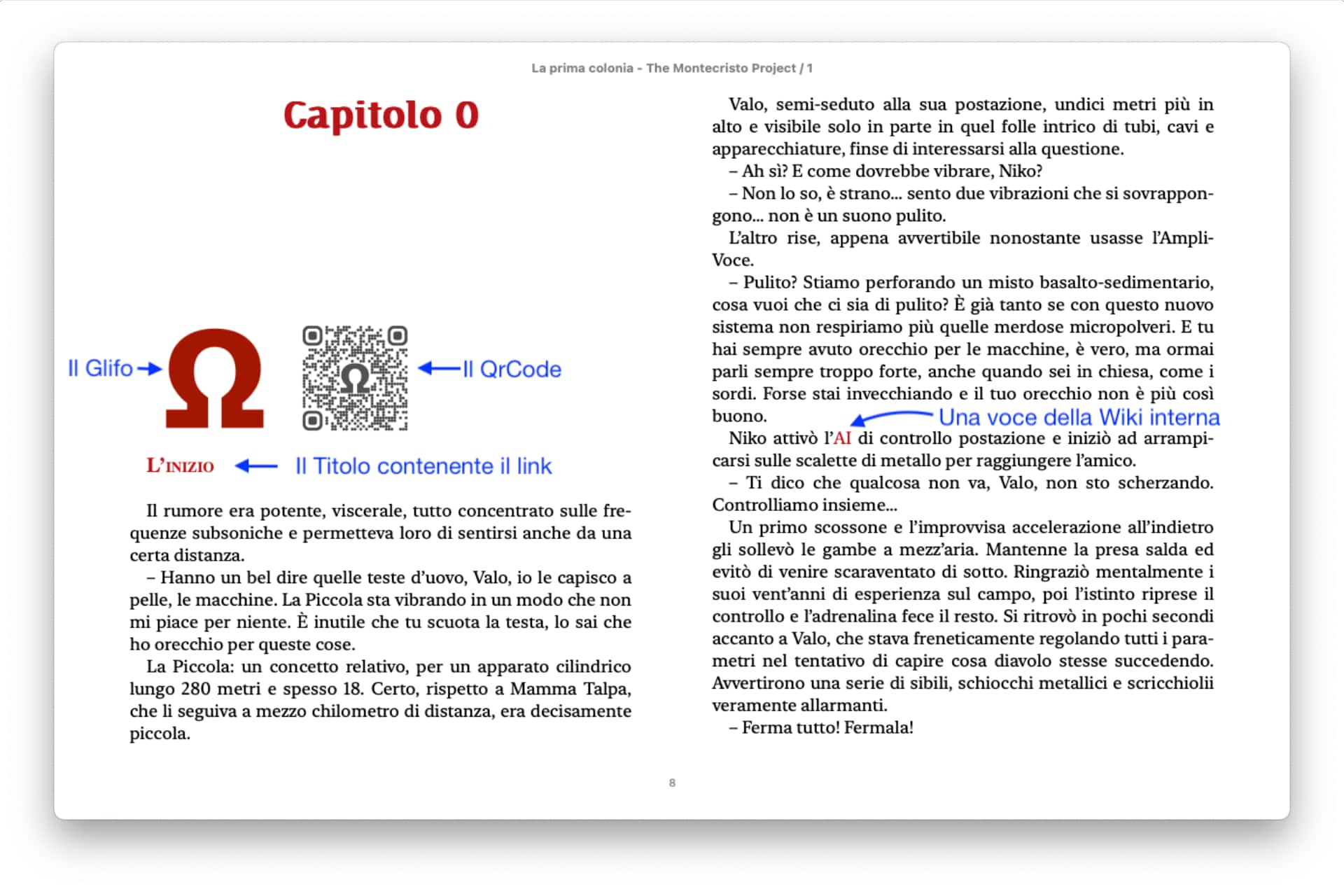
The image above shows a sample page from the eBook, the digital edition of The Montecristo Project – La Prima Colonia. The blue labels identify the various elements on the page.
Each scene is preceded by a Glyph: a symbol, a letter from any alphabet, part of a scientific formula, or something else. The Glyph provides an additional key to interpreting the scene. It has a symbolic and semantic connection with the scene’s content that readers may discover for themselves, find clues to on the related web page, or uncover through a combination of both.
Beside the Glyph is a customised QR code. Scanning it with a smartphone opens the scene’s web page if the eBook reader does not support internet browsing. If it does, the QR code also contains a link to the same page, which can be opened directly from the eBook reader. The same link is embedded in the Title.
In the second column, the term AI appears in red: this indicates that it is a reference in the internal Wikinet, and clicking it opens the corresponding entry, such as the one shown below:
The Internal Wiki of the Digital Augmented Book
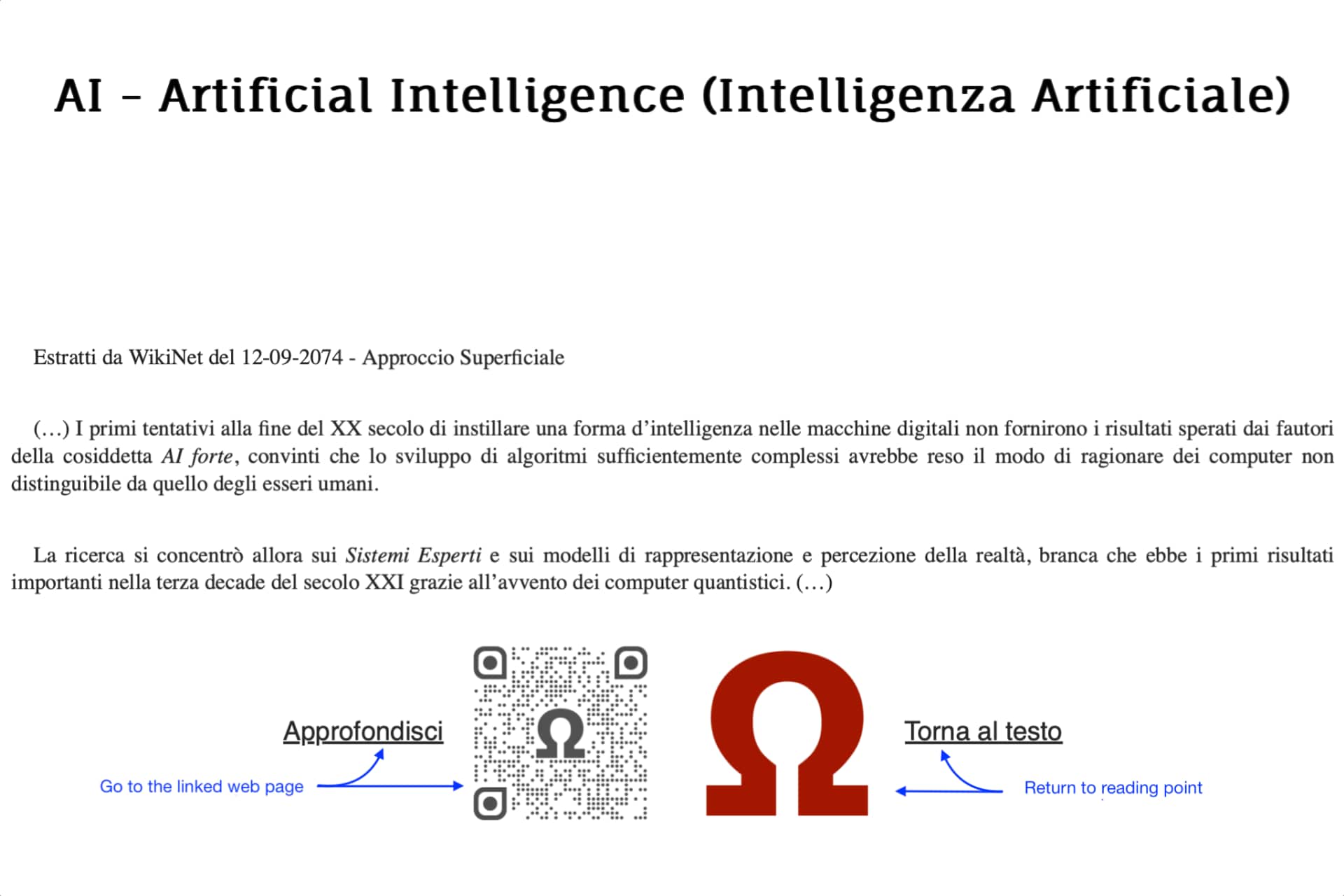
Above you can see the first entry (reference) in the digital book’s internal Wikinet on the subject of AI – Artificial Intelligence. In this example it is very short, but each entry grows as the plot develops.
At the bottom are two options. On the left, the Learn more link and the QR code both lead to the reference’s web page, where I will gradually add a third level of detail. On the right, the Glyph and the Back to the text link return readers to the reading position from which they started.
Navigation within the digital augmented book is therefore kept as simple as possible, allowing readers to move smoothly through a fairly complex hypertext structure distributed across multiple media.
The Print Augmented Book
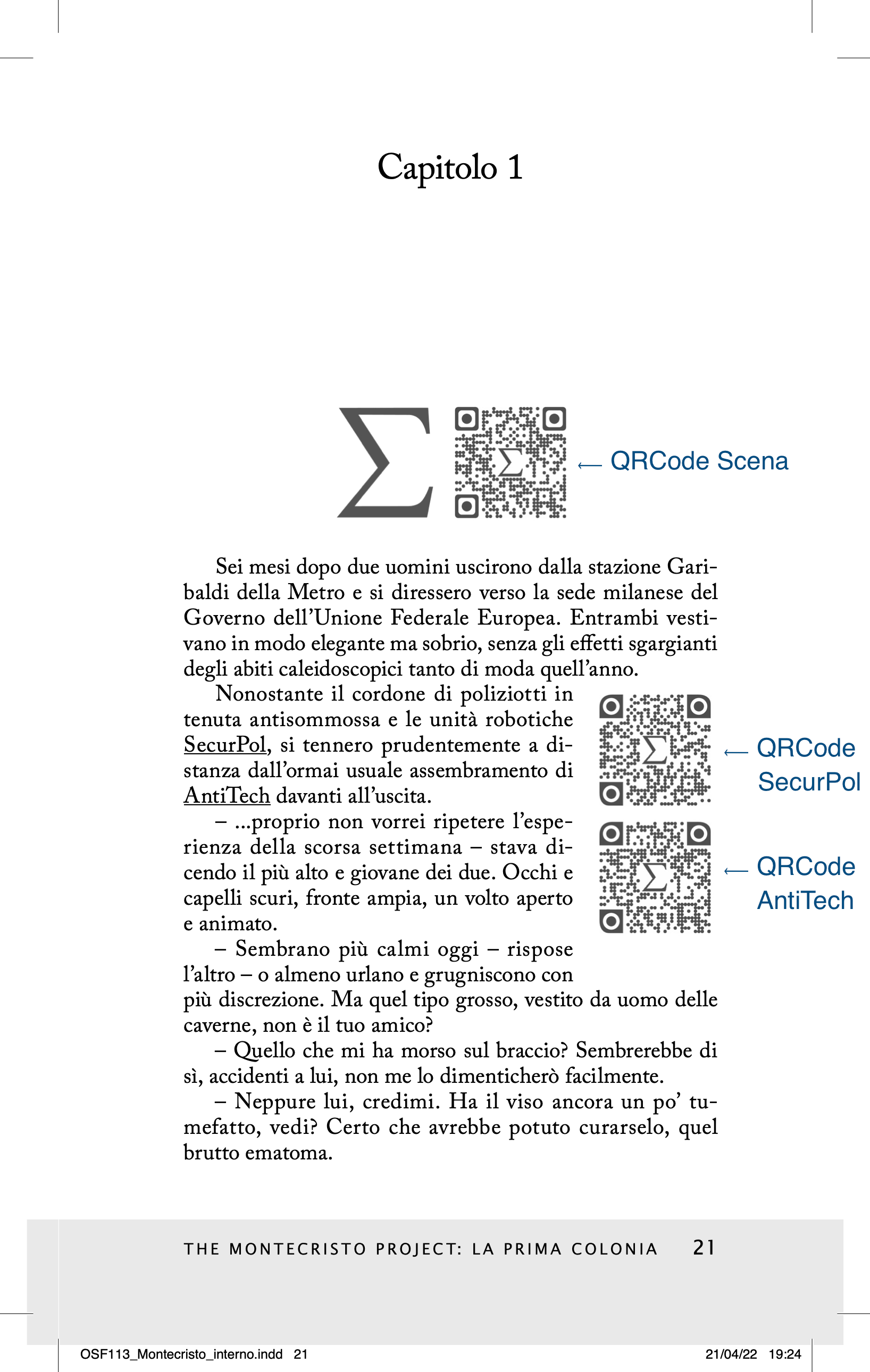
By contrast, this is how the first page of Chapter 1 appears in the print edition of a Prima Colonia (the same method was also used for Tempesta). Here too, the blue labels identify the page’s “interactive” elements.
While we wait for the wonders of graphene-based electronic paper – currently being researched at the Sant’Anna School of Advanced Studies in Pisa – print books must, for the time being, “make do” with customised QR codes to provide access to background, multimedia and interactive content.
This page contains no fewer than three QR codes: in addition to the one leading to the scene’s web page, there are two references to the dedicated wiki, which is also available on the web: SecurPol and AntiTech.
A Few Final Questions
-
What Is an Augmented Book?
An augmented book is a text published in print or digital form that, while preserving linear reading, provides access to supplementary materials that explore and enrich the text itself.
-
Do You Need an App to Read an Augmented Book?
No dedicated app is needed. For the print book, all you need is a smartphone or tablet capable of reading QR codes to access the extra materials. For the electronic book, if the reading device supports internet browsing, everything can be accessed on the device itself. Otherwise, a smartphone or tablet can be used exactly as with the print book.
-
Is an Augmented Book the Same as an eBook?
-
Is an Augmented Book the Same as an Augmented-Reality Book?
No. An augmented book is an innovative approach to adding digital layers to a “traditional” book, whereas augmented reality is a specific technology that uses a device’s camera and screen to overlay digital elements on images of the real world. An augmented book may include augmented reality, but it does not have to.
-
What Do You Think of the Augmented Book?
I worked hard to find this solution, which is both simple and rich in interesting possibilities. It allows the book to be read linearly, without having to jump to footnotes every time. A solution based on “traditional” footnotes would almost double the length of the print book and, in any case, would be neither practical nor as engaging as the current approach.
At the same time, the augmented book gives readers a convenient way to explore the story in greater depth and interact with both the story and the author. Clearly, none of this would have been possible without the full support of Delos Digital not to mention the infinite patience of its founder, Silvio Sosio.
The future will bring ever more refined and versatile versions of the augmented book. In my view, however, the important thing is for linear reading always to remain the book’s “basic interface”: “Deep roots are not reached by the frost,” wrote someone who is very important to me.
I would love to know what you think. You can write about it in the Facebook Group or on the Facebook Page, or on Twitter or LinkedIn. I look forward to hearing from you.
Edoardo Volpi Kellermann
Writer, musician and science communicator. Since 2010, he has been developing an
augmented-book model applied to the science-fiction novel The Montecristo project
Last updated 30 July 2026