Is writing purely a matter of intuition and instinct, or does it need plans and structures to tell a story coherently?
Introduction
Everyone has their own way of telling stories, composing music and thinking.
A dear friend wrote in a—lovely – review that my writing resembles my music. Whether I should take that as a compliment (it was certainly meant as one) or as criticism is for the reader – or the listener – to decide.
What is certain is that my writing is not linear, as someone else pointed out rather critically. Nor is my music primarily melodic; if anything, it is more “layered”.
Today, neuroscience is showing, through targeted analyses and functional MRI scans, that the brain relies on several overlapping networks when operating intuitively and rationally. Here too, then, we are faced with a dichotomy that makes little sense.
The image below presents the results reported in a peer-reviewed article published in 2015 in Frontiers in Human Neuroscience, 9, 456. The article, entitled “Do intuitive and deliberate judgments rely on two distinct neural systems? A case study in face processing”, was written by Laura F. Mega, Gerd Gigerenzer and Kirsten G. Volz.
The upper part of the image, obtained through a conjunction analysis, shows the “common core” active in both conditions across the various scans, including the fusiform gyrus, cuneus and inferior occipital cortex. The lower part shows the relative differences.
Intuitive Writing: Onion Writing
I like layers. In music they become polyphony, polyrhythm and polytonality; in writing, they can become entries in the internal wiki, glyphs, music, shifts in perspective, sudden stylistic mutations, choral subplots and densely interwoven threads. I can hold myself back and try to control my instinct so as not to become too cryptic or unfocused, but I cannot deny my own nature. It is how I love to represent reality: as complexity (which is not the same as complication).
When I write or compose, I work through “successive brushstrokes” (yes, Roberto Rizzardi, you hit the mark like the finest Zen archer), and this way of proceeding comes with problems. The first is that I never have a precise idea of where the story is heading until the whole plot—or rather, the weft running through the warp, in a Robert Jordan-style metaphor – unfolds in my mind. The characters act according to their emotions and their own logic, so all I can do is follow them and hope they show me the way.
The same happens with the events of the story, which at a certain point seem to follow one another independently of my will. In short, “a great semantic muddle”, as I wrote elsewhere.
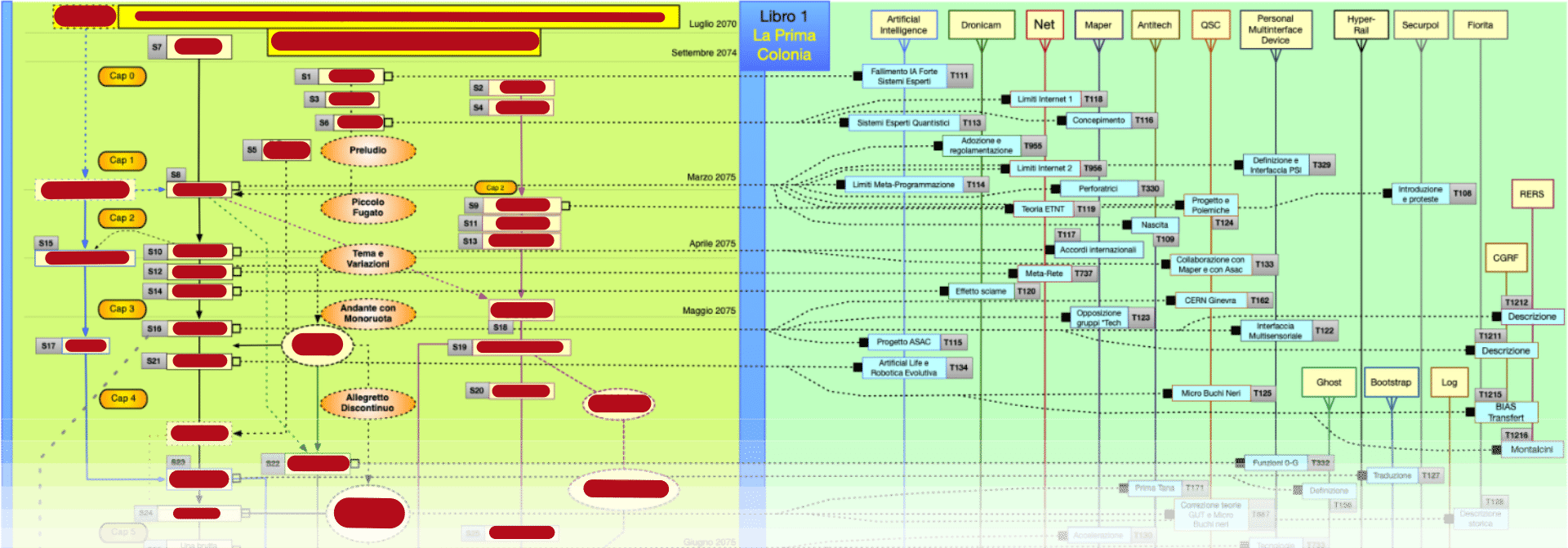
Part One - The first section of the outline for The Montecristo Project: The First Colony, created with OmniGraffle and suitably obscured to avoid spoilers.
Pattern Writing: The Advent of OmniGraffle
Saga has been—and remains—essential for gradually organising all the material in chronological order and with the correct links, without losing my way or being overwhelmed by anxiety. Yet none of this would be enough without a precise concept map.
I have used concept maps since time immemorial without ever wondering who first defined and theorised them, or when. Wikipedia (!) tells me it was Joseph D. Novak, a learning theorist, beginning in the 1970s. We can never be grateful enough to him.
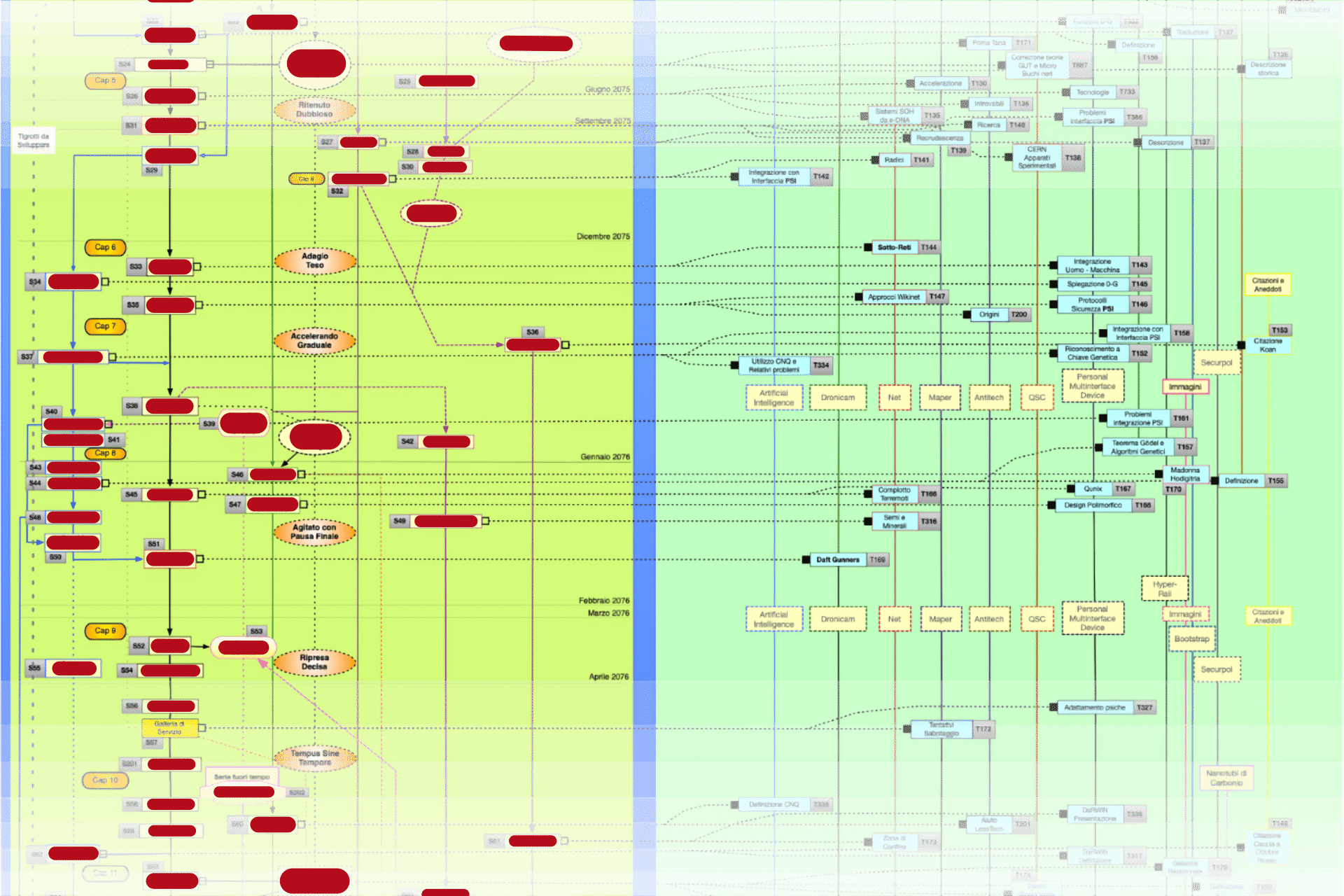
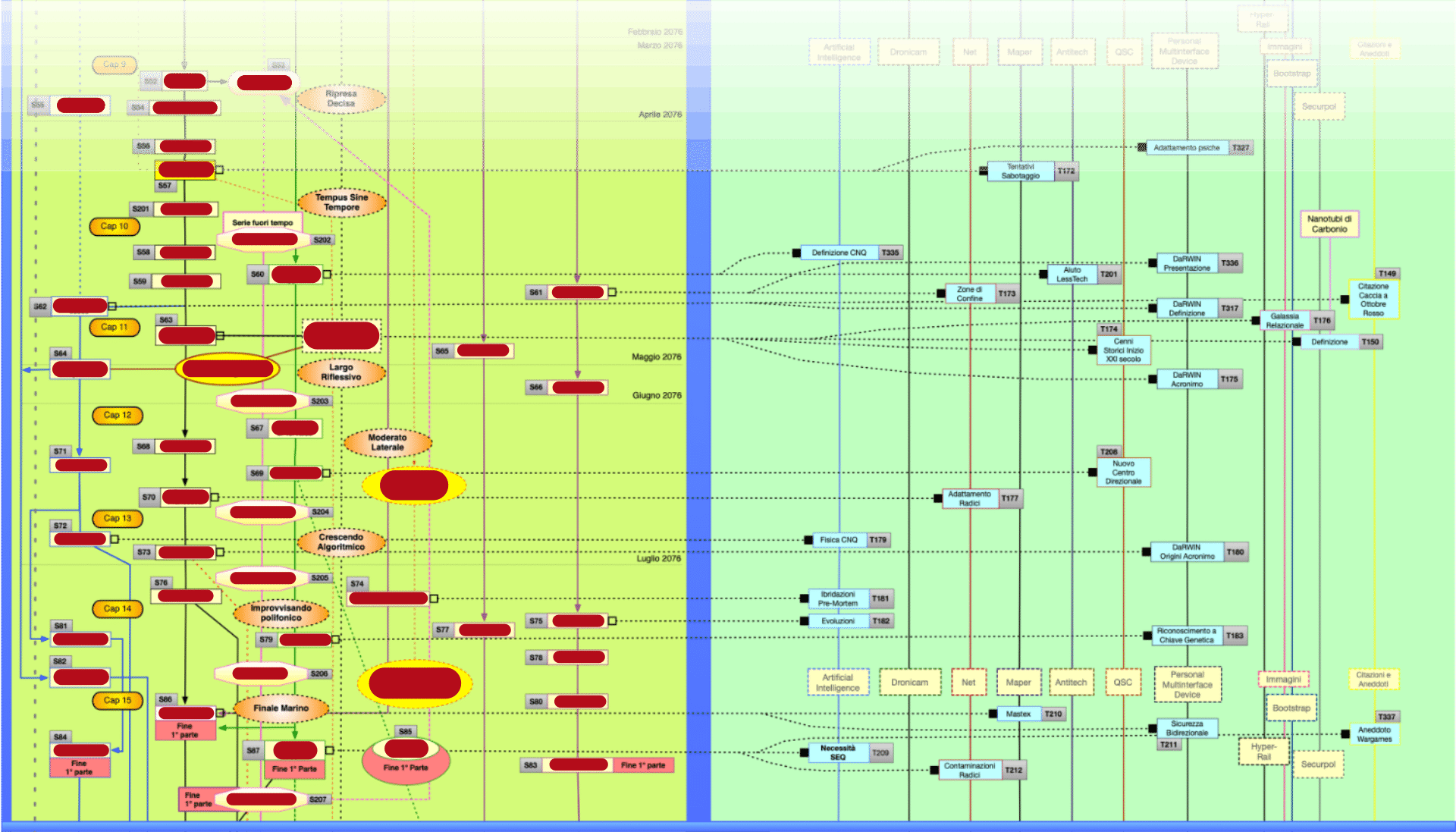
My software choice was OmniGraffle, developed by The OmniGroup, an American software company specialising in productivity tools, first for the NeXt platform (the ancestor of Apple’s current operating system) and later for Mac and iOS. With OmniGraffle I built the outline you can see in sections on this page, with the scene descriptions hidden: revealing too much in advance is bad, don’t you think? Almost as bad as the Italian pseudo-Anglicism spoilerare.
The second section of the outline for The Montecristo Project – The First Colony, created with OmniGraffle.
Beati monoculi in terra cæcorum
Why did I not hide the descriptions of the elements on the right-hand side of the outline? Because those are entries from the dedicated Wikinet and cannot reveal anything about how the story unfolds.
In addition to tracking the development of the main plot and the subplots, the map shows all the links between the scenes and the corresponding entries in the Wikinet (which I call “references”). To the left of each element is a number identifying it within Saga, either as a scene or as a reference.
The chapter titles, as you can see, reflect my musical background, but also a certain nerd or geek sensibility, depending on how you interpret those terms (there is no real consensus on the distinction).
Finally, each element is also a link to the corresponding webpage, whether it refers to a scene or to an entry in the internal Wikinet.
Blessed are the one-eyed in the land of the blind.
The third section of the outline for The Montecristo Project – The First Colony, created with OmniGraffle
Intuitive or Structured Writing: Cui Prodest?
This is certainly not meant as advice on how other people should write and develop their stories. Nor is it merely a way of saying, “Look how nerdy or geeky I am.”
Rather, it is a long and verbose personal outpouring, for which I hope you will forgive me. After so many years of work, during which I have racked my brains to overcome, on the one hand, my age-old laziness and, on the other, the complexity of creating a reasonably coherent secondary world, letting you see how I managed it—or at least, how I hope I managed it—is part of the process of sharing.
And that, after all, is an author’s ultimate aim: to create something beautiful and engaging, to give something of oneself, and to receive in return the emotional and intellectual engagement of those who experience it. For better or worse. Every writer’s dream, in other words. But in the end, cui prodest – who benefits?
The heptapods’ writing in Denis Villeneuve’s film Arrival, adapted from Ted Chiang’s short story “Story of Your Life”, expresses their nonlinear perception of time.